One linkage principle, several possible directions
Gene Bachman's patented linkage system is intended as an alternative to certain conventional four-link mechanisms found in everyday tools and machines. The prosthetic-knee mechanism is the first application actively in development; the categories below illustrate where a three-link replacement could plausibly apply — not current products.
These are separate from the specific examples the issued patents use to illustrate the mechanism itself (a basketball hoop mount, a vehicle seat, a camera mount, a robotic arm, and a scissors mechanism) — see those drawings on the Inventor and Patents page. Neither list is exhaustive; the patent claims describe the linkage structure, not a fixed set of products.
Mobility Devices
The prosthetic-knee mechanism is the application actively in development and the source of the current prototype. The goal is a lighter, reduced-link alternative to the six-link reference mechanism used in comparable prosthetic-knee designs. Development is early-stage; the mechanism has not been clinically tested, medically approved, or confirmed safe or effective for human use.
Seating Systems
The technology's origin in an adjustable ATV seat-height mechanism (U.S. Patent 10,328,822) suggests a natural extension into other adjustable seating applications, where a compact linkage could adjust height or position along a defined path. This remains a direction to evaluate rather than a developed application.
Automotive Mechanisms
Reduced-link geometry that generates a controlled motion path may have relevance to suspension linkages and door hinges, where component weight and packaging space are ongoing design considerations. These directions have not been engineered, tested, or validated for automotive use.
Tools
Hand tools that rely on linked members to multiply force and control jaw or blade movement — compound-action garden shears among them — are a familiar category worth evaluating for part count, weight, operating force, and manufacturing cost. See the worked example below.
Lifting Systems
Many jacks and lifting mechanisms use four-link or scissor-style geometry to convert input force into a controlled lifting path. A reduced-link alternative could plausibly be evaluated for part count, weight, or operating force in this category — none of that evaluation has been done yet.
Other Motion-Control Applications
Gene Bachman believes the linkage principle may have broad adaptability across mechanical products that rely on a controlled motion path — but this is a belief about potential, not a verified or proven claim about any specific number of applications. Next EV To Do is open to discussing licensing or co-development for uses beyond those listed here.
Garden Shears
Compound-action garden shears demonstrate how linked members can multiply force and control jaw movement. They provide a familiar example for evaluating whether an alternative linkage could affect part count, weight, operating force, range of motion, manufacturing cost, or durability.
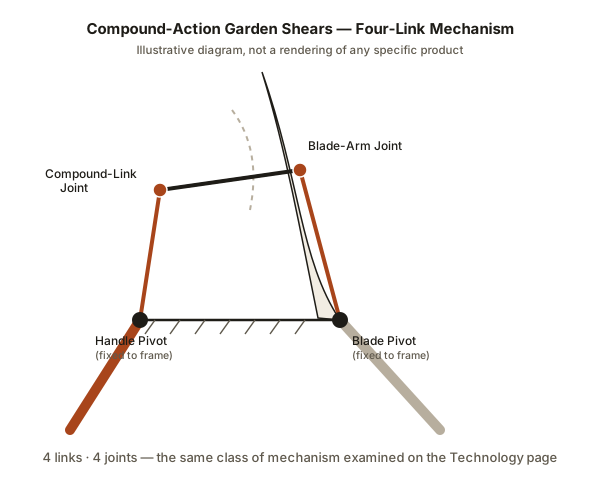
Garden Shears Photograph
Reserved for an original photo of the actual garden shears, shot against a clean neutral background, once ownership of the image rights is confirmed.
Issued patent US 11,059,395 does include a scissors-type embodiment (FIG. 14B–14E) showing the same three-link principle applied to a forward-thrusting scissors mechanism — see it on the Inventor and Patents page. That figure is a general scissors mechanism from the patent drawings, not a garden-shears prototype specifically — the example here remains illustrative only.
Could This Architecture Improve Your Mechanism?
Next EV To Do is seeking qualified manufacturers and engineering teams willing to identify an appropriate four-link product, define measurable performance requirements, and compare the patented linkage system with the existing design.